


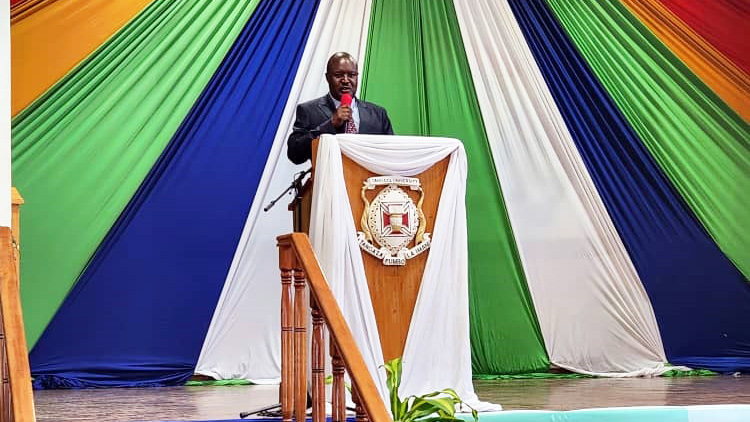
The President of the Pan-African Parliament (PAP), H.E. Chief Fortune Charumbira, today issued a powerful continental call for Africa to assert full sovereignty over its sensitive digital data and the Artificial Intelligence systems built upon it, as he officially opened the Sensitive Data Sovereignty Conference at Tangaza University in Nairobi.
Addressing senior university leaders, policymakers, researchers, humanitarian actors and technology experts, President Charumbira warned that Africa risks a new era of data colonialism if urgent steps are not taken to control ownership, storage and use of African data — particularly sensitive health and humanitarian data.
“If we do not control the data that goes into Artificial Intelligence, we will not control the AI that shapes our future. Data sovereignty is not merely a technical issue — it is a matter of human dignity, cultural identity, and Africa’s right to define its own development path,” President Charumbira declared.
Africa’s Data: A Strategic Resource That Must Remain African-Owned
The PAP President emphasised that Africa is rich in digital data but that much of this sensitive information is stored and processed beyond the continent’s borders, raising critical questions of ownership, benefit-sharing, privacy, and national security.
He cautioned that uncontrolled external access to African data enables:
- Privacy violations
- Economic exploitation
- Political manipulation
- Erosion of African cultural and knowledge systems
“Until the lion learns how to write, the story will always glorify the hunter. Africa must write its own digital story — with African data, African rules, and African values,” he stated.
Pan-African Parliament Advancing Continental Legal Protection
President Charumbira reaffirmed that the African Union has already placed Data Sovereignty and Artificial Intelligence at the heart of Agenda 2063, and that PAP is implementing its legislative mandate accordingly.
He announced that the Pan-African Parliament will shortly begin developing a Cybersecurity and Artificial Intelligence Model Law to assist AU Member States in strengthening data protection, privacy and digital rights, building on the AU Malabo Convention on Cybersecurity and Personal Data Protection.
Universities Leading Africa’s Data Sovereignty Agenda
The President made these remarks as Patron of the Africa University Network on FAIR Open Science (AUN-FOS), officially inaugurated during the conference. The network brings together Tangaza University, the University of Nairobi, Mekelle University, Equator University of Science and Technology, Great Zimbabwe University and Grand Bassa University, alongside partner institutions across the continent.
He commended African universities for safeguarding independent African innovation, knowledge production and ethical leadership in the digital era.
A Platform for African Solutions in Health and Humanitarian Data
The conference — organised by Tangaza University in collaboration with the University of Nairobi — focuses on building an African Humanitarian and Health Data Space, enabling Artificial Intelligence innovation while ensuring that ownership and control of sensitive data remain with African institutions and communities.
This work is grounded in FAIR and FAIR-OLR data principles and supported by African engineers in the VODAN network, alongside international research partners.
A Call for United African Action
President Charumbira concluded with a continental call to governments, academia, private sector, civil society and international partners to unite behind Africa’s data sovereignty agenda.
“We need an African Data Space where knowledge is generated without losing control over data ownership. This is African engineering for Africa. Together, we can build an Africa where data empowers our people and secures our collective future.”
He then formally declared the Sensitive Data Sovereignty Conference open